
A Seemingly Benign Issue
In July 2017, after several months of unknown stomach and intestinal issues, I (Kaden) was diagnosed with a form of Irritable Bowel Disease (IBD). At the time, the diagnosis seemed simple and straightforward, and the GI doctor told me to take a prescription medication called Apriso (mesalamine) and I would be totally fine. The casualness of both the diagnosis and prescription put myself and my family at ease, leading us to believe this was a minor diagnosis and I would be totally okay.
After a couple years of on and off struggles with managing the disease, and several life changes, including moving from Florida to Boston for college, then to Seattle for an internship and eventually full-time role in 2021, I sought out a new GI in April 2021 to help review my case and determine a path forward with my IBD in Seattle.
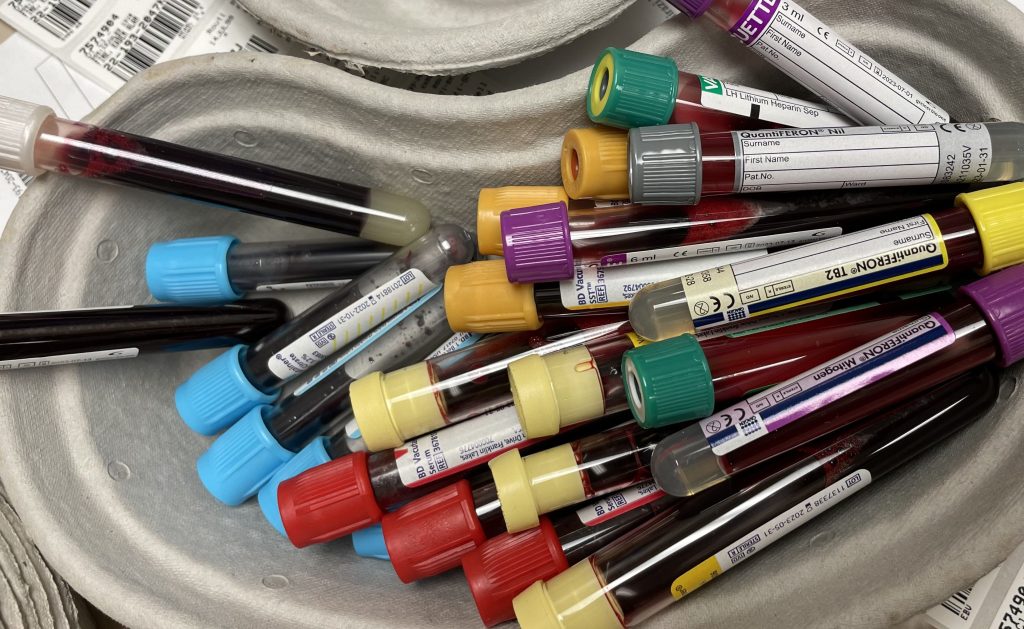
The first step my new GI wanted to pursue was a simple blood test to figure out where I was at internally. I remember getting this blood drawn late on a Friday, and felt a little sick over the weekend, thinking nothing of it.

The Revelation
The following Monday at 8am on the dot I received a call from my doctor. I was in the middle of my Monday morning meeting, and thought the call was very odd so I stepped out and answered it. She asked “Kaden, has anybody ever mentioned anything about kidney issues to you before?” I said no, I had no family nor personal history and wasn’t sure what she was referring to.
She quickly told me something was very wrong, as my kidney function results showed function below 10%. She said I needed to go to the ER right away to figure out what was going on.
After many confusing and stressful hours in the ER that Monday morning in April 2021, it had seemed I had some kind of extreme inflammation in my kidney, eventually assumed to be related to the medication I was taking for my IBD. This was a known, but incredibly rare side affect of the medication Apriso, but was usually caught much earlier than mine. When caught earlier, it doesn’t usually lead to permanent damage. This risk and need for constant blood testing monitoring was never mentioned to me when it was prescribed to me at the young age of 17, seemingly a factor of lazy and poor medicine.
I was admitted to the hospital for treatment.

The False Hope
The nephrologist (kidney specialist) in the hospital believed because I was young and otherwise healthy, I would be able to recover enough kidney function to avoid the need for a transplant at any point in my life. While the multiple day stay in the hospital out of the blue was very rough for me, I had hope that this would just be a small blip in my life and I would be able to move forward normally after a few months of treatment.
I was released from the hospital a few days later, prescribed a concoction of heavy drugs, and was told everything would be okay. For the next few months, through Fall 2021, some of my lost kidney function recovered, peaking at around 20% of total capacity. This was far below what the nephrologist had estimated, and hope was on its way out the door.
My nephrologist didn’t want to give up, and after a fight with my insurance company, we got approval for a new, experimental medication that cost over $1,000,000 to administer. Unfortunately, after several months, the treatment yielded little to no results. It was now summer 2022, I had a fraction of the expected kidney function, and I felt hopeless.
The Correction
I sought a second opinion, now switching to the University of Washington (UW) nephrology team, a leader in kidney care research and development. I met with Dr. Ahmad Malik, a head of nephrology at UW, and asked for his take on my case.
As I had begun to suspect, he reviewed my case and listened to my story, and told me with a heavy heart that I “had simply been dealt a bad hand” and simply had too much scarring to ever recover enough. I would most definitely need a kidney transplant, likely sooner rather than later. This felt like a lot more realistic to me at this point, and I accepted my fate. In summer 2022 I changed care to Dr. Malik and team, and begun the patient transplant evaluation process. I was listed for a deceased kidney donor in late 2022, as a third level of backup behind living donors.

The Surprise at the Finish Line
I was fortunate that my kidney function was holding in the 15-20% range for most of 2022 and 2023, which generally enabled me to live a normal life. Because I took great care of myself and followed all the doctor’s instructions to the T, I was able to live these years relatively healthily, with the impending transplant always at the back of my mind.
I was very fortunate that my younger sister, Shiloh, who is three years younger than me, was both willing and qualified to donate her kidney. This was the plan for these years, and we were in a holding pattern until my kidney function dropped naturally to a point where we needed to kick into gear and get everything ready for the actual transplant surgery.
As of mid-2024, it was clear that my kidney was on its way out. In fall 2024, we began the process of having my sister Shiloh evaluated as the donor. Everything was looking rock solid – our blood types were perfectly compatible, we were siblings so other immuno-typing matched, and she was young and healthy, making donation a no-brainer.
Right at the last second, on the last step of donor evaluation, the medical team responsible for her evaluation flagged a genetic anomaly called C3 glomerulopathy, an incredibly rare genetic disease (1 per million people globally) present in my kidney. Because it is a genetic condition, the team declined Shiloh as a donor, fearing that if it were to ever present in her body, it would be very hard for her to survive with only one kidney.
This was discovered and confirmed in early February 2025, with the original timeframe for surgery to be March 2025. That meant in order for the original timetable to be present, I would have to find, evaluate, and schedule surgery within 3 weeks, where usually there is at least a 12-16 week lead time. Clearly, this was not doable.

For context, the average eGFR (a measure of kidney function) for a 26 year old is 100+ (not even shown on my chart).
Today
After a strong pivot, I will now be beginning dialysis, as my kidney function is now at 5% and no longer is sustaining my daily life. I will active on the deceased donor list, but this is suboptimal to receiving a live donor. Live donor kidneys, on average, last 30-50% longer than deceased kidneys, and live donor kidneys generally lead to much better outcomes.
I am now in search of a new live donor who isn’t related to me. I need to get someone evaluated and confirmed ASAP to lower the awful load that dialysis puts on my life and my body.
Please see the “How” tab to learn more about how kidney transplantation works, why it is so vital to receive a live kidney, and how you can begin the donor evaluation process.
 Kidney 4 Kaden